A research team led by Prof. LIU Chengli and Prof. XIONG Xiong from the School of Geophysics and Geomatics, together with collaborators, has made significant advances in studying great earthquake rupture processes. Their findings, titled “Simple unilateral rupture of the great Mw 8.8 2025 Kamchatka earthquake”, were published online in Science. This research provides crucial scientific evidence for understanding how megaquakes develop, how they rupture, and how they interact with volcanic systems.
How great earthquakes develop and rupture in subduction zones, and their potential effects on volcanic systems, has long been a central question in seismology. On July 29, 2025, an Mw 8.8 megaquake struck offshore southern Kamchatka Peninsula, Russia—the seventh largest earthquake globally since 1900. Significantly, this earthquake occurred almost exactly where the 1952 Kamchatka Mw 8.8-9.0 event took place, offering a rare natural laboratory for comparative studies of great earthquake preparation and rupture patterns.
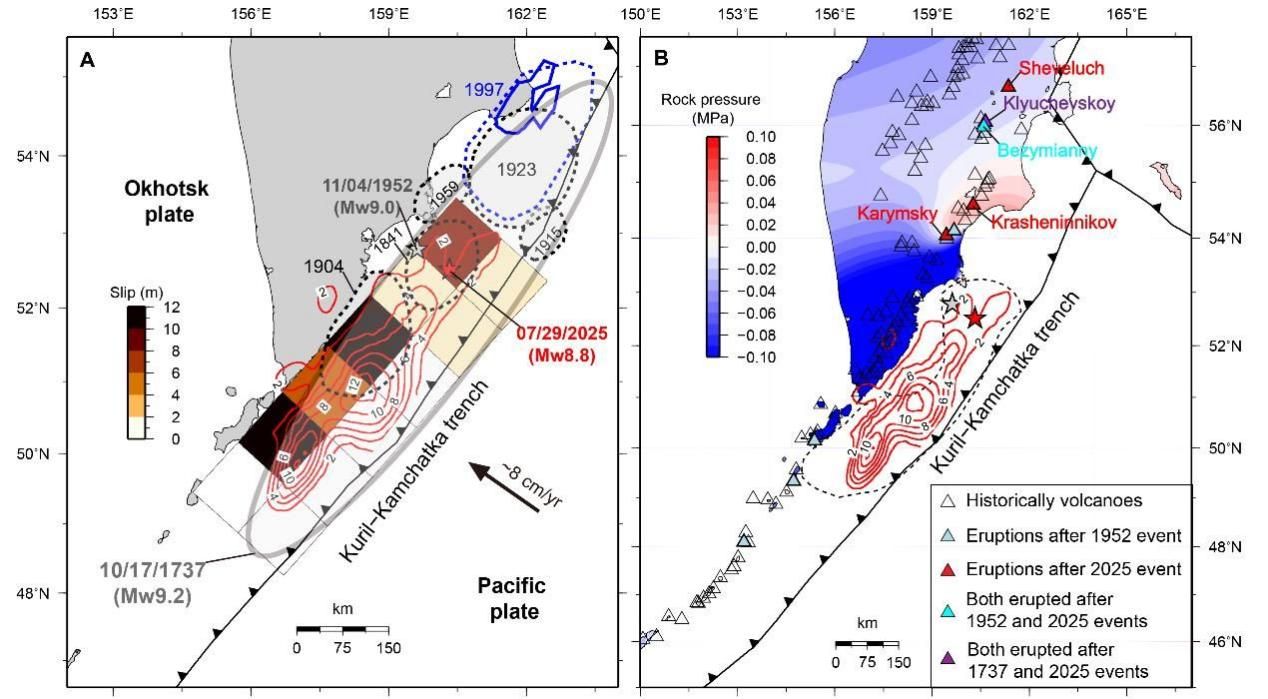
Great earthquakes and their interaction with volcanoes along the southern Kamchatka subduction zone
This research advances scientific understanding of how great earthquakes rupture in subduction zones, providing important scientific support for tsunami risk assessment, long-term seismic hazard analysis, and volcanic activity monitoring and early warning.
Link: https://www.science.org/doi/10.1126/science.aeb8232
(Edited and translated from the Chinese version)